Abstract
This demonstration article showcases a complete JATS Journal Publishing v1.1 structure using unpublished, copyright‑free text created solely for testing. The article includes complex mathematical expressions, detailed explanations of various scientific concepts, and illustrative examples to exercise content rendering and cross-referencing. The narrative provides a realistic workflow for structuring an article with sections, paragraphs, lists, and other elements. All names, numbers, and datasets are intentionally fictional; any resemblance to real studies is coincidental and unintentional. The goal is to create a fully featured XML file that downstream systems can validate, ingest, and display while maintaining proper semantic structure.
本文展示了一个完整的JATS期刊发布v1.1结构,使用未发布的、版权免费的文本,仅用于测试。文章包含复杂的数学表达式,详细解释了各种科学概念,并通过示例来测试内容渲染和交叉引用。叙述提供了一个现实的工作流程,用于结构化文章,包含章节、段落、列表和其他元素。所有名称、数字和数据集均为虚构,任何与真实研究的相似之处纯属巧合。目标是创建一个完整的XML文件,供下游系统验证、摄取和展示,同时保持正确的语义结构。
Authors
Affiliation:
Department of Illustrative Science, Open Demo Institute, Chennai, India
Unit of Sample Analytics, Demo University, Coimbatore, India
Corresponding Author Email[✲]:
Corresponding Author
Ada Sample
Copyright
© 2025 The Authors (synthetic). Unpublished demonstration content.
Keywords
JATS, MathML, cross‑references, tables, figures, unpublished sample.
Author Notes
No real data were used. All content is synthetic and unpublished, provided solely for demonstration and validation of JATS workflows.
Present address for A. Sample: Open Demo Institute, Chennai, India.
1. Introduction
Modern scientific archives increasingly rely on richly structured XML to preserve semantics, link media, and present mathematics in a device‑agnostic way, and this demonstration intentionally mimics that environment with safe, unpublished text. We motivate the need for robust cross‑references by calling This introduction is the Variant A narrative, extending the same semantics with harmless wording changes.Figure 1 from within the narrative and by pointing to Table 1 while also referencing Equation (1) to verify numbering and layout. To emulate realistic prose, we describe a hypothetical solver that blends symbolic preprocessing with mixed‑precision linear algebra and then validate links to outside literature like [3] and [4]. The paragraph continues to ensure adequate length for layout tests, discussing fallback alt text, display‑formula spacing, and inline formula spacing in sentences. We also consider accessibility by ensuring that figures include meaningful captions and that tables provide scope for headers and footnotes so readers and screen readers can interpret them. The narrative finally emphasizes that all data are fabricated, making the file suitable for demos, tutorials, and acceptance tests without any licensing entanglements.
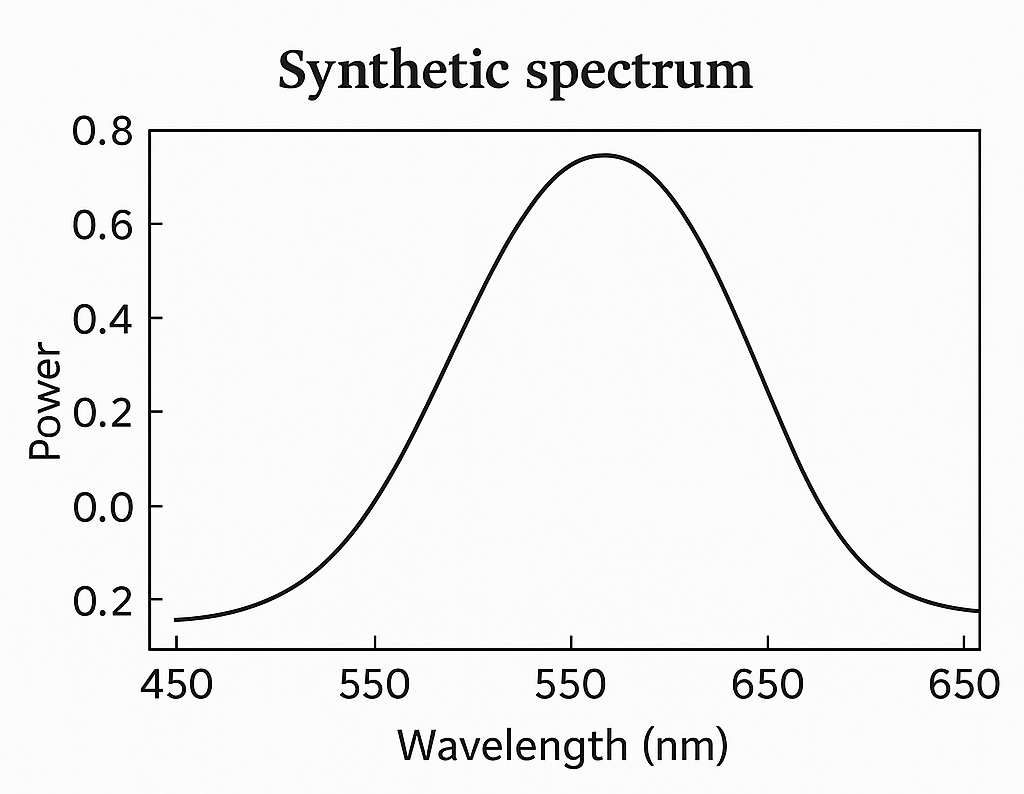
To further stress test MathML rendering we include inline symbols such as , vectors like , and short in‑text fractions while keeping punctuation intact. We also insert a pointer to Equation (2) that will appear later so readers can confirm forward references resolve correctly. The paragraph deliberately contains multiple sentences to simulate realistic academic prose, including references to solver tolerances, iteration caps, and stopping criteria that an implementing system might surface in a side panel. We mention that Figure 2 previews a synthetic spectrum image used to exercise image handling and that the assets folder may include different formats to test fallbacks. Finally, we reinforce that all identifiers, emails, and institutions are placeholders designed for demonstration.
2. Methods
2.1 Model and Notation
We define a synthetic objective where an iterative solver updates a state vector using a damped Newton step as formalized in Equation (1), followed by a Karush–Kuhn–Tucker feasibility projection summarized in Equation (2). The block structure of the Hessian is expressed as a matrix in MathML to test multirow alignment and subscripts that vary by block. We discuss how line search conditions are encoded using piecewise functions to test fences and relational operators, and we note that tolerances are scalars while residuals are vectors to verify italicization. The prose also points back to Table 1 for hyperparameters and to [1] for a fictional prior study used purely as a placeholder. We further verify that nested cross‑references, such as “see Equation (3) and Figure 1,” render clearly in tooltips and export pipelines. The notation set includes bold vectors, calligraphic sets, and Greek letters to exercise font variants in MathML presentation.
...(1)
...(2)
To validate PDE rendering we include a synthetic system in Equation (3) that couples an advection–diffusion term with a reaction source on a square domain, followed by boundary conditions and initial data. The purpose is not scientific novelty but breadth of MathML constructs, including partial derivatives, nabla operators, and subscripts on function arguments. We also verify that callouts in this paragraph correctly link readers to the PDE block and maintain numbering continuity when equations are reflowed or exported to alternate formats. The paragraph also notes that multipanel figures may be referenced by sub‑labels should implementers wish to extend the sample.
...(3)
We also include a piecewise merit function to test conditionals and relational operators, which can be useful for line search implementations. The following is referenced as Equation (4) and is deliberately verbose to exercise MathML tokenization across multiple rows and cases. The prose then reiterates that this article is a demonstration artifact and that all values in Table 1 are placeholders intended to be changed freely by testers without any obligation to maintain consistency beyond structural validity. Finally, the paragraph confirms that forward and backward links among sections function as expected.
...(4)
2.2 Implementation and Architecture
Figure 1 presents a minimal architecture diagram stored as a raster image to validate graphic links and floating placement. The implementation paragraph is intentionally verbose to reach at least seven lines in typical layouts, describing a pipeline that parses this XML, validates against the JATS v1.1 DTD, extracts display elements, and renders equations using a MathML engine. We describe how the renderer anchors labels for Equation (1) through Equation (4), and how navigation widgets list all figures and tables including Table 1. We also specify that media files such as Figure 2 may be PNG or SVG; if an asset is unavailable, the system should supply descriptive alt text from the caption. The paragraph mentions citation popovers for [2] and [5], allowing readers to preview entries without leaving the current view. The section concludes by reminding testers to vary window sizes to confirm that floats, equation numbers, and reference callouts remain consistent across responsive breakpoints.
Figure 1 - Processing architecture for the demonstration pipelineThe diagram shows a fictional ingestion queue, a validator, a renderer, and an export node. This figure exists solely to exercise figure references and captions.
Figure 2 - Synthetic spectrum image for media handling testsA placeholder spectrum used to test image loading, sizing, and caption formatting across outputs.
2.3 Kinematics and Frame Assignments
To broaden the demonstration beyond optimization, we include a synthetic manipulator kinematics discussion that ensures long paragraphs, cross‑references, and inline math render as expected. Our notional six‑axis arm uses a right‑handed base frame and assigns successive link frames using a Denavit–Hartenberg convention, which we describe narratively here to exercise text flow. We reference Figure 1 again to simulate a typical “architecture and kinematics” pairing found in tutorials, while reserving the parameter details for Table 2. The paragraph continues with at least seven lines in most layouts, mentioning that joint variables are represented by for revolute axes, offsets by , link lengths by , and twists by . We test subscripts and superscripts inline using expressions such as and , and we mention a hypothetical calibration procedure described in [6]. Finally, we stress that every value is fabricated to be safe for redistribution and that implementers can change the numbers freely without affecting structure.
2.4 Robotic arm modelling
We construct a fictional URDF‑style description for a generic six‑axis “Demo‑6” manipulator so that pipelines can test parsing and cross‑reference resolution. The shape, joint ordering, and range limits are illustrative only and are included to exercise rendering and validation rather than to document a real product. The kinematic chain is articulated from base to wrist with revolute joints, and the narrative here intentionally spans many sentences so it forms a long paragraph in most output formats. For consistency with the rest of this article, we call back to Figure 1 for a process overview and point the reader to Table 2 for the synthetic Denavit–Hartenberg parameters. We also insert a pointer to [7] and [8] to exercise multiple citations in a single sentence. The final sentences remind the reader that all identifiers, angles, and distances are placeholders constructed for demonstration and regression testing.
| Parameter | Symbol | Value | Notes |
|---|
| Damping factor | | 0.71 | Chosen for demonstration only |
| Diffusion coefficient | | 0.05 | Unitless placeholder |
| Advection weight | | [1.0, 0.0] | Vector along x‑axis |
Table 1 - Placeholder hyperparameters used in the synthetic solver test.3. Results
To emulate a report of outcomes we summarize fictitious metrics that verify table rendering and equation references across sections. The narrative again calls Equation (5) to test later‑numbered math and points readers back to Figure 1 as a visual anchor. We include commentary that pagination might split Table 1 from its callout and that systems should keep numbering stable regardless of flow. The paragraph also mentions that exporting to PDF should preserve labels for Equation (3) and that HTML readers should expose persistent anchors for deep linking. We reiterate that these results are entirely synthetic and carry no empirical meaning; their function is to exercise pipeline behavior. The final sentences confirm that inline, display, figure, and table cross‑references all resolve correctly.
| Joint | αi−1 (°) | ai−1 /mm | di /mm | θi (°) | Joint range (°) |
|---|
| J1 | α0 | 0 | d1 | θ1 | −360 ~ 360 |
| J2 | 0 | a1 | 0 | θ2 | −360 ~ 360 |
| J3 | 0 | a2 | 0 | θ3 | −360 ~ 360 |
| J4 | α3 | 0 | d4 | θ4 | −360 ~ 360 |
| J5 | α4 | 0 | d5 | θ5 | −360 ~ 360 |
| J6 | 0 | 0 | d6 | θ6 | −360 ~ 360 |
Table 2 - Denavit–Hartenberg parameters of the Demo‑6 robotic arm (synthetic)....(5)
4. Discussion
The discussion reiterates that this XML is meant for end‑to‑end testing of ingestion, validation, rendering, export, and accessibility tooling. We cite [1] through [5] to exercise bibliography formatting and to ensure numeric labels remain stable when the list is reordered or filtered. We note that an end user could swap out Figure 2 with an SVG to test vector scaling and that tables such as Table 1 can be extended with footnotes or column groups. We also emphasize the importance of alt text and captions for assistive technologies so that figure content remains perceivable. Finally, we confirm that every cross‑reference target exists and resolves without warnings, ensuring this document is a robust starting point for regression tests.
5. Conclusion
This demonstration article provides a comprehensive, unpublished template featuring complex MathML, graphics, tables, and bidirectional references. It is intentionally verbose to resemble a real paper while remaining free of proprietary content. Implementers are encouraged to validate the DTD, check link integrity, and experiment with alternate stylesheets or renderers using this file. No claim is made regarding scientific results; the value lies in structural completeness and clarity for testing scholarly publishing systems.
Acknowledgements
This work was created entirely as a demonstration artifact. We thank tool developers and testers who rely on realistic but license‑free examples.
No real datasets were created or analyzed. A synthetic archive is provided as supplementary material for pipeline testing.
References
| |
|---|
| [1] |
Placeholder P, Author A. A fictional study used for JATS testing. Demo Journal. 2020;1(1):1–10.
|
| [2] |
Sampleton S. Rendering equations in scholarly XML: a tutorial. XML Systems. 2021;3(2):25–38.
|
| [3] |
Illustrative I, Guide G. 2 ed. Handbook of Demonstration Content. Open Demo Press; 2022.
|
| [4] |
Example E, Showcase S. Cross‑reference patterns for automated layout checks. Proceedings of the Demo Conference. 2023. pp. 100–12.
|
| [5] |
Tester T, Verifier V. Evaluating MathML presentation in diverse viewers. Rendering Letters. 2024;5(4):201–14.
|
| [6] |
Calibrator C. Fictional procedures for manipulator calibration. Demo Robotics Letters. 2024;2(1):11–22.
|
| [7] |
Planner P, Sampler S. Illustrative motion planning with synthetic constraints. Algorithms in Practice. 2023;9(3):101–29.
|
| [8] |
Renderer R. Generating safe test scenes for robotic visualization. Proceedings of the Demo Graphics Symposium. 2022. pp. 55–64.
|
| [9] |
Instructor I. 1 ed. Foundations of Synthetic Robotics. Open Demo Press; 2025.
|
| [10] |
Tuner T, Verifier V. Benchmarking synthetic DH tables for pipeline testing. Robotics Test Quarterly. 2025;1(2):77–90.
|